
In a time where breathwork has exploded and become the next best thing, it's important to clarify and discern our intention when entering any breath experience. I've been working with the body for over 25 years and more deeply with breath over the last 7 years, and there is such a thing as too much too soon.
Yogic breathwork has always been used to move prana, our life force, to purify and balance the body, and to quiet the mind in preparation for meditation. My background in breath stems from yogic teaching alongside functional movement, anatomy and nervous system science. And after years of tuning my breath through this lens, in 2009 I found Sudarshan Kriya, the rhythmic circular breathing practice taught by Sri Sri Ravi Shankar through the Art of Living.
After 2 days of vegan diet, no caffeine, connection with other participants, teachers, meditation and yogic breathwork, we moved into the Sudarshan Kriya, 90 minutes of breathing rhythmically to mantra. We did this again the following day. Needless to say, this experience changed my life. After the long kriya, when we lay down to rest, I released. I laughed and cried and had never felt so tuned in and grateful. I experienced my heart, God, my connection to divine. There really are no words to describe an experience like this.
It wasn't just the circular breath kriya that made my experience so profound. It was after 2 days of deep connection with myself and others, steady breath and meditation practices, and a true feeling of safety. This allowed me to experience all of the layers, including discomfort, that the actual full breath journey brought.
I loved this experience so much, I continued learning through the Art of Living for two years and began my pathway to become a teacher, serving by teaching yoga and breathwork through the organization. I traveled to India for continued growth, meditation and to be of service.
In 2020 I started exploring Holotropic Breathwork, Stanislav Grof's work, and followed teachers he'd taught. I fell in love with the freedom of movement during journey. In kriya, we sat upright for the full 90 minutes of breathing, moving through different rhythms led by Sri Sri Ravi Shankar's mantras. The release and non-ordinary states usually came afterward, when we lay down. In Grof's work, we follow our own rhythm and are free to move and deeply express during the breath, so the releases, visions and downloads happen as we breathe. And lastly, Grof used evocative, loud sound to help reduce the resistance of the mind and evoke emotional release. Similar to the kriya, his work is experienced over 2 to 3 days, creating a safe space with plenty of room to experience and express.
My work, Somatic Breath Journey, falls somewhere in between these two spaces. I deeply honor both lineages, and the parallel between the two is that safety is the priority. If the body doesn't feel safe, the journey will fall flat or push you toward fight or flight.
After several years studying and practicing Sudarshan Kriya and years exploring through Stanislav Grof's work, I've woven them into my own way of guiding. We begin with structure and safety, as in Kriya, and then I encourage each person's breath find its own rhythm, as in Grof's work, so there's freedom to move, release and ultimately trust your own body's readiness for expansion.
How a journey unfolds
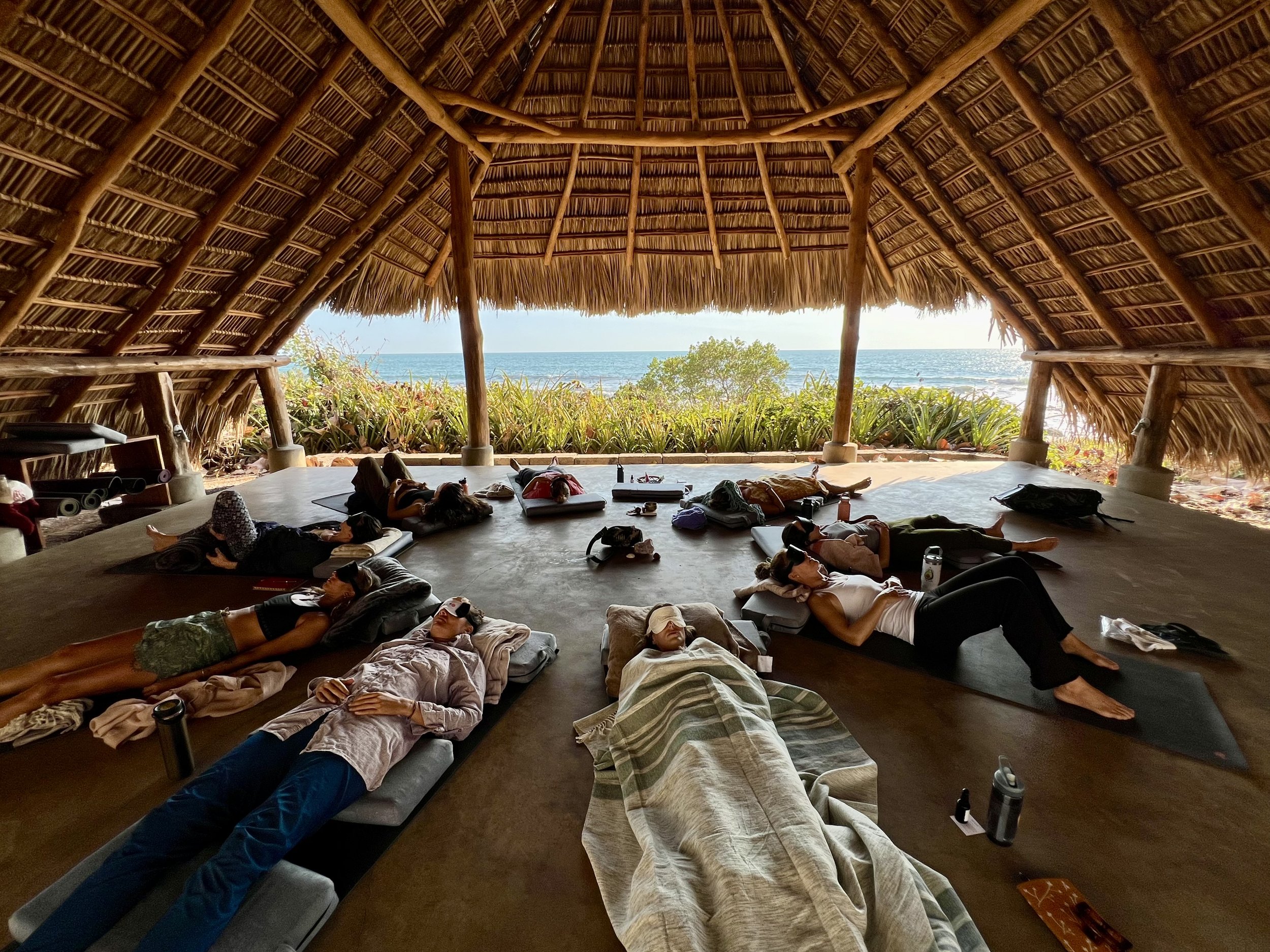
I start my breath journey sessions slowly, checking in and letting everyone settle. We begin with feeling the body, downregulating breath to help the nervous system find neutral, so that we feel safe. From there, we move into deeper breaths and sustain them in a circular rhythm. And before you know it, the breath begins to lead, and the mind and body let go. The set-up encourages an organic neuro-emotional awakening.
Each journey is woven with a soundscape I've created, and I add to it with the drum, rattles, bells and chimes to help guide the breath and the journey, and to move us into non-ordinary states of consciousness. The mind is so strong, so we've got to shake it up and literally rattle it!
What may arise
At the beginning of each journey, I share the states that might arise to ease the mind and create safety for each participant. There are three kinds of experience.
Physical release is full expression through the body. It can show up as tingling, temperature changes (that's why layers are important), pressure and tension. Sometimes the hands cramp and curl, which is common in breathwork. We simply allow these sensations to come and move our bodies through them.
Emotional release is often where the most resistance shows up. You might start to feel frustrated, angry or irritated, even with the facilitator or the music. That's usually an expression needing to come through. Vocalizing, making sound, moving, shaking or breathing more strongly can help stir it up and let it out.
Spiritual opening is when whatever is happening in the imagination comes forward. You might see or hear guides, ancestors or symbolism. Rather than questioning it and going back into the mind, we allow it to come, to show us, to teach us and to be there for us.
Resistance shows up in a myriad of ways! You might stop breathing early in the journey. It's totally normal to take pauses, but when it happens very early, it's usually a form of resistance or checking out. Yawning can be similar: it can be a release, but also a way of resisting deeper breathing. The mind is so protective. It can start to say "this isn't working," or many other things, to keep us from going deeper. When these thoughts arise, we notice them and come back to the breath in a steady circular rhythm again and again.
Ultimately, you’re in control.
What's so magnificent about a breath journey, as opposed to a psychedelic journey: you're really in control, through your breath.
If at any time you are too uncomfortable, you can slow or lighten your breath. If you long for more, you might quicken it or choose a different rhythm. Each will accent your journey. Quicker breathing can bring about deeper release, and slower breathing can ease the release if it starts to feel like too much too soon. That's all within your control. I am a guide, giving suggestion based on my many years of study and experience, but ultimately, this is your journey and you choose the path forward.
Closing and integration
Integration is so important, and it happens slowly. As our bodies move back toward neutral at the end of the journey, things start to integrate on their own. There may be a sense of coming together, or another emotional release. We allow time as the body returns to neutral and we breathe naturally. Some of us might feel like drawing, writing or continuing to lie there, and we honor that time. Then we gather in an integration circle. Sharing often helps bring the whole vision together, but it's always optional. I usually offer chocolate, warm tea and maybe some essential oil to help ground us.
Who is it for?
Breath journey can be for anyone, but it may not be right for everyone. It's for anyone ready to slow down, feel more and reconnect with themselves. No breathwork experience is needed, only a willingness to breathe, feel and allow.
A Somatic Breath Journey is intended as a personal growth experience and is not a substitute for therapy or medical care. It can bring strong emotional and physical release. This journey is not appropriate if you are pregnant, or if you have cardiovascular problems, severe high blood pressure, epilepsy, glaucoma, a detached retina, a severe mental illness, a recent surgery or fracture, or an acute infectious illness. If you have osteoporosis or asthma, please check with your doctor first, and if you have asthma, bring your inhaler.
If you have any doubt about whether this journey is right for you, please consult your physician or therapist, and reach out to me before booking.
What to bring: comfortable layers plus an extra cozy blanket or sheepskin, a journal or sketchpad, and a water bottle. Eye masks are provided, or bring your own.
So looking forward to welcoming you to breath at one of my upcoming journeys.
All Breath Journeys and are listed on the Retreats and Gatherings Page.